
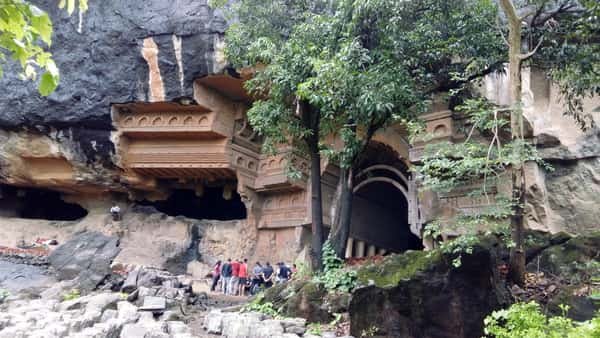
Deep in the forested hills outside Karjat, the approach to Kondana changes character with the season. In the dry months, trekkers follow a woodland trail towards a rocky cliff; during the monsoon, streams cross the path and water pours dramatically over the ancient cave façade. Hidden behind this landscape are Kondana Caves, also called Kondhane Caves, a group of early Buddhist rock-cut monuments that can also form part of the steeper Karjat-side trekking route towards Rajmachi.
The caves are particularly interesting because history and trekking meet at the same place. Instead of driving directly to a monument, visitors walk through the Sahyadri landscape to reach a group of caves dating to around the 1st century BCE. Those wanting a longer adventure can continue uphill towards Rajmachi and its twin fortified peaks, Shrivardhan and Manaranjan. Maharashtra Tourism specifically identifies Kondana as ancient Buddhist caves accessible by a scenic trek.
Kondana Caves Quick Information
| Information | Details |
|---|---|
| Location | Near Kondhane village, Karjat region, Maharashtra |
| Type | Ancient Buddhist rock-cut cave complex |
| Period | Around 1st century BCE |
| Number of Caves | Commonly documented as 16 |
| Known For | Buddhist architecture, trekking, forest and monsoon scenery |
| Nearest Major Town | Karjat |
| Nearest Railway Station | Karjat Railway Station |
| Typical Base | Kondhane/Kondiwade side |
| Trek Difficulty to Caves | Easy to moderate for regular walkers |
| Further Trek | Kondhane Caves to Rajmachi |
| Best for Comfortable Trekking | Post-monsoon and winter |
| Monsoon Attraction | Waterfalls, streams and dense greenery |
History of Kondana Caves
Kondana’s history goes back much further than the Maratha forts for which the Sahyadris are famous. The caves are associated with the early Buddhist period and are generally dated to around the 1st century BCE.
The complex contains 16 Buddhist caves, with architectural elements associated with religious worship and monastic life. The rock-cut structures include a chaitya, or prayer hall, and viharas used by Buddhist monks.
Their location was not accidental. Ancient routes through the Western Ghats connected the coast with settlements and trading centres of the Deccan. Buddhist establishments were frequently developed near important trade corridors, where merchants and travellers could support religious communities.
Today, the surviving stonework gives visitors an opportunity to see an archaeological site within its natural Sahyadri setting rather than inside a heavily urbanised tourist zone.
Architecture of Kondana Caves
The caves were carved directly into the basalt rock. Their architecture is particularly valuable for understanding early Buddhist rock-cut construction in western India.
One of the most notable features is the chaitya, the ceremonial prayer space. Architectural details imitate forms associated with earlier wooden construction, demonstrating how builders transferred timber architectural ideas into stone.
The complex also contains viharas with cells intended for monks. Sculptural and decorative remains can still be observed, although parts of the complex have suffered damage over time.
The cliff itself adds to the experience. During heavy monsoon rain, water descends over portions of the cave frontage, temporarily transforming the archaeological setting into a waterfall landscape.
Kondana Caves Trekking Route
The commonly used approach begins from the Karjat side.
Travellers first reach Karjat and then continue towards Kondiwade and Kondhane village. Local road transport can cover much of the distance from Karjat before the walking trail begins. One travel guide estimates roughly 40 minutes for the road journey from Karjat to the base area, depending on transport and conditions.
From the base, the trail passes through vegetation and follows the hillside towards the caves.
For someone visiting only Kondana Caves, this can be managed as a relatively short trekking excursion. Maharashtra Tourism describes the caves as accessible through a picturesque trek and notes that monsoon conditions may involve stream crossings.
The situation changes considerably if you continue towards Rajmachi.
Kondana Caves to Rajmachi Trek
Experienced or well-prepared trekkers can extend the trip by continuing uphill from the caves to Rajmachi.
Rajmachi is not a single hilltop structure. Its fortifications include the twin forts of Shrivardhan and Manaranjan, with Udhewadi village serving as the settlement below them.
The Karjat approach through Kondhane is considerably steeper than the alternative Lonavala approach. Published trekking information generally places the Kondhane-to-Rajmachi ascent at roughly 2.5 to 4 hours, depending on the starting point, weather and individual pace.
The route continues through forest and climbing sections before reaching the Rajmachi plateau and Udhewadi. From there, trekkers can separately climb towards the fortified peaks.
Do not treat the short Kondana Caves walk and the complete Rajmachi ascent as the same trek when planning your time and fitness requirements.
Trek Difficulty
For most reasonably active visitors, the trek to Kondana Caves alone is relatively approachable. The trail becomes more demanding during rain because wet rocks, mud, flowing streams and reduced visibility can increase difficulty.
Continuing all the way to Rajmachi requires considerably more stamina. The Karjat-side route gains elevation and involves a longer climb through the hills.
First-time trekkers visiting during heavy monsoon conditions may benefit from travelling with an experienced group or local guide.
Best Time to Visit Kondana Caves
There are two very different experiences depending on when you visit.
June to September brings the dramatic monsoon landscape. Forests become intensely green, streams fill with water and seasonal waterfalls appear around the caves. This is visually impressive but also when the trail can become slippery and stream crossings more difficult.
For travellers who prioritise easier walking conditions, post-monsoon and winter months are generally more comfortable. Maharashtra Tourism notes that the site can be visited throughout the year while highlighting the lush setting created by the monsoon.
Avoid entering streams or standing beneath powerful waterfalls simply for photographs. Water volume can change rapidly during heavy rainfall.
How to Reach Kondana Caves
By Train
Karjat Railway Station is the practical railhead for the Karjat-side approach. Karjat has rail connectivity with the Mumbai region and lies on an important railway corridor towards Pune.
From Karjat, travellers can use local road transport towards Kondiwade/Kondhane before beginning the trek.
By Road
Travellers coming by private vehicle can approach the base villages through Karjat. Road conditions closer to trekking areas can vary considerably with the season, particularly during the monsoon.
From Mumbai
Reach Karjat first by train or road and proceed towards Kondhane. Starting early is advisable if you intend to continue beyond the caves to Rajmachi.
From Pune
Travellers from Pune can approach the Karjat region by road or rail. Those primarily interested in Rajmachi should also compare the Lonavala approach, which is generally gentler than climbing from the Kondhane side.
What to Carry for the Trek
Wear trekking shoes with reliable grip rather than smooth-soled casual footwear. Carry sufficient drinking water, light food, basic first-aid supplies and personal medication.
During the monsoon, waterproof protection for your phone and valuables is useful. A rain jacket is generally more practical on narrow trails than relying entirely on an umbrella.
Avoid leaving plastic bottles, food wrappers or other waste around the caves or along the trekking route.
FAQs About Kondana Caves
Q1. Is Kondana Fort the same as Kondana Caves?
A. Reliable tourism and historical sources identify the site near Kondhane as Kondana or Kondhane Caves, an ancient Buddhist rock-cut complex. The fort reached by continuing uphill is Rajmachi, which includes the Shrivardhan and Manaranjan fortified peaks.
Q2. How old are Kondana Caves?
A. The Kondana Caves are generally dated to around the 1st century BCE, making them roughly two thousand years old. They contain important examples of early Buddhist rock-cut architecture.
Q3. Is the Kondana Caves trek difficult?
A. The trek to the caves is generally considered manageable for reasonably fit beginners, but rain can make the trail slippery. Continuing from the caves towards Rajmachi is longer, steeper and more physically demanding.
Q4. How do I reach Kondana Caves from Karjat?
A. Reach Karjat Railway Station and take local road transport towards Kondiwade and the Kondhane area. From the base, continue on foot through the forest trail to the caves.
Q5. Can I trek from Kondana Caves to Rajmachi Fort?
A. Yes. The Kondhane route continues uphill towards Udhewadi and the Rajmachi fortification. It is the steeper Karjat-side approach and normally requires several additional hours of trekking beyond the caves.